Selected Film Reviews: Drama M-Z
Click on the film title to read the full review.
For a complete chronology of film reviews, visit the Publications page.
“The Letter of the Lawless” (review of Joseph Losey’s M), Chicago Reader, October 31, 2013. “Though the [classic German crime thriller M (1931)] contained very little location photography, its sets connoted a closed, repressive world of cramped streets and iron gates. The action created the sense of a teeming underworld and a relentless police department, their easy coexistence in a corrupt Berlin disrupted by one little man who can’t control his urges. … That stifling sense of gated enclosure evaporates in the [1951] remake, which was shot on location in the wide-open spaces of LA.”
“Movie Monsters” (review of David Cronenberg’s MAPS TO THE STARS), Chicago Reader, March 12, 2015. “The old cliche in Hollywood stories is an aging actress getting kicked to the sidelines by a younger, fresher one, but screenwriter Bruce Wagner gives this a millennial spin by making teenagers the wary veterans. … Benjie isn’t old enough for high school, but already he has to worry about aging out of the business; once the Bad Babysitter sequel begins shooting, he realizes he’s being upstaged by his eight-year-old costar and fights to get the towheaded kid thrown off the picture.”
“Stars of Stage and Screen” (review of Marcel Pagnol, Marc Allegret, and Alexander Korda’s “THE MARSEILLES TRILOGY”), Chicago Reader, February 9, 2017. “A tale of parenthood and its heartache, the movies [Marius (1931), Fanny (1932), and César (1936)] struck an emotional chord in France and were enormously successful. … [Playwright Marcel] Pagnol’s accomplishment with the Marseille Trilogy was to embrace the keen emotion of stage melodrama and yet, working with [film] directors Alexander Korda and Marc Allégret, scale it down to the intimate space of the cinema.”
“Sounds of the Street” (review of Haskell Wexler’s MEDIUM COOL), Chicago Reader, July 11, 2013. “Medium Cool was ahead of its time in recognizing the awesome political power of the camera, something we all reckon with now in a surveillance society where a cell phone lens can become a private citizen’s last avenue of defense against the police. In the end, though, Wexler’s understanding of the camera’s importance may not be as valuable as what he actually shot back in 1968, scenes that gave voice to marginalized Chicagoans long before the so-called democratization of media.”
“Public Enemy Numero Un” (review of Jean-Francois Richet’s MESRINE), Chicago Reader, September 2, 2010. “[Jacques] Mesrine’s criminal career paralleled [John] Dillinger’s in many ways. Each man specialized in bank robbery, playing up the Robin Hood appeal of stealing from powerful financial institutions. Each escaped from police custody after being apprehended and staged a daring prison break to bust out his comrades. Each was proclaimed public enemy number one in his respective country and became a media star, fascinating the public. And each proved so dangerous to law enforcement officials that eventually he was more or less executed on the street—Dillinger with a pistol shot to the back of the head as he strolled from the Biograph theater in July 1934, Mesrine in a hail of rifle fire as he sat in Paris traffic in November 1979.”
“The Media and Modern Warfare” (review of Michael Winterbottom’s A MIGHTY HEART), Chicago Reader, June 22, 2007. “Michael Winterbottom’s docudrama A Mighty Heart isn’t the first movie about the 2002 murder of Wall Street Journal reporter Danny Pearl by Islamic militants. That would be The Slaughter of the Spy-Journalist, the Jew Daniel Pearl, the notorious three-and-a-half-minute video made by his killers, which included shots of a masked executioner severing Pearl’s head and holding it aloft by the hair.”
“Gay Power” (review of Gus Van Sant’s MILK), Chicago Reader, November 27, 2008. “Van Sant and screenwriter Dustin Lance Black manage to pull off the same balancing act between the movement and the mainstream that made Harvey Milk such an effective politician in 70s San Francisco. By capturing Milk as a person, the movie helps all viewers empathize and find common cause with him; by observing Milk as a politician, it offers activists a practical lesson in the use of power 30 years after his death.”
“Baseball’s Bargain Basement” (review of Bennett Miller’s MONEYBALL), Chicago Reader, September 22, 2011. First Place, Best Arts Criticism, Association of Alternative Newsmedia, 2012. “More than any other team sport, baseball focuses our attention on individuals trying to realize their true potential, which is what makes the grand slams so sweet and the strikeouts so bitter. Moneyball asks us to root for a team whose management saw every player not as a person capable of greatness but as a set of stats to be fed into an algorithm. If you’ve just lost your job as a result of some digital innovation, this is probably not the movie to cheer you up.”
“When the Author is the Auteur” (review of Rodrigo Garcia’s MOTHER AND CHILD), Chicago Reader, May 20, 2010. “[Garcia’s films are] writerly in the best sense of the word: they focus on characters, and the story springs from who these people are rather than putting them through their paces. When Garcia’s films succeed they do so on the strength of his writing, and when they fail their shortcomings can usually be traced back to the writing as well.”
“Location, Location, Location” (review of Kleber Mendonca Filho’s NEIGHBORING SOUNDS), Chicago Reader, January 31, 2013. “Writer-director Kleber Mendonca Filho, making his feature debut after a handful of shorts and a documentary, has drawn comparisons to Robert Altman for his weaving together of many characters inside and around a middle-class high-rise in a suburb of Recife, the capital city of Pernambuco. Distinguishing him from Altman, though, is a sure grasp of how people try to define—and are more often defined by—the spaces they inhabit.”
“Home Is Where the Hate Is” (review of Ramin Bahrani’s 99 HOMES), Chicago Reader, October 1, 2015. “Bahrani’s extraordinary new drama … takes on the subprime mortgage meltdown of 2008 with its tale of a young man who loses his home in a foreclosure and, desperate for work, becomes the reluctant protege of the very same real estate shark who turned him out. Few other dramas have dared to address the housing bubble that ruined so many Americans, and none with the sense of personal immediacy, of real lives affected, that Bahrani brings to his story.”
“Boots on the Asphalt” (review of Peter Berg’s PATRIOTS DAY), Chicago Reader, January 19, 2017. “Patriots Day functions mainly as a police procedural, chronicling the five-day manhunt for the two lone-wolf jihadists who [bombed the Boston Marathon in 2013], and in that regard it’s more valuable than any sort of exercise in healing. Within the confines of a hard-charging action flick, Berg and his coscreenwriters present a clear account of how media frenzy and fear of more attacks drove federal and local law enforcement to execute the first military-style lockdown of an American city.”
“Live From New York: How Rod Serling’s Patterns Elevated TV Drama” (review of Fielder Cook’s PATTERNS), Perisphere, August 22, 2025. “Patterns shows how sophisticated live TV drama had grown in the seven years since television became a commercial medium. Director Fielder Cook … cuts back and forth between seven sets as more than 20 actors play scenes in real time. The sense of a pressurized work environment is palpable because, for the actors and crew, it was one.”
“Exiled to the Art House” (review of Vincent Paronnaud and Marjane Satrapi’s PERSEPOLIS), Chicago Reader, January 10, 2008. “Most people don’t like having to follow type at the bottom of a movie frame any more than they’d like hearing someone call out the harmonic changes during a symphony. One reason U.S. movies are ubiquitous abroad and foreign movies are ghettoized here may be that we insist on subtitling imports when most other countries accept dubbing; during the silent era, when intertitles could be switched out easily, there was a much healthier exchange of world cinema.”
“Two Little Hitlers” (review of Mohsen Makhmalbaf’s THE PRESIDENT), Chicago Reader, February 4, 2016. “The fable of a leader going incognito among his people is as ancient as the King Arthur legend and as modern as the last days of Saddam Hussein; Makhmalbaf turns it into a story at once timeless and contemporary, eventually pushing past the immediate matters of guilt and comeuppance to ask whether democracy can ever flourish amid an endless cycle of oppression and revenge.”
“History vs. Hollywood” (review of Michael Mann’s PUBLIC ENEMIES), Chicago Reader, July 2, 2009. “As a Chicagoan, I make a point of being annoyed instead of starstruck when film crews take over city streets. But my resistance melted away one afternoon last spring when I turned the corner onto the 2400 block of Lincoln and saw it dressed to look as it did the day John Dillinger was shot down by federal agents outside the Biograph. Walking past the theater, its marquee ringed with a banner that read cooled by refrigeration and iced fresh air, I felt as if I’d stepped into an old gangster movie.”
“The Cop Who Loved Women” (review of Oren Moverman’s RAMPART), Chicago Reader, February 23, 2012. “[Woody Harrelson stars as a renegade LAPD] officer, nicknamed ‘Date Rape Dave’ for rumors that he killed a serial date rapist 12 years earlier. [There are] assorted beatings and shootings as the crime story unfolds. But what actually dominates on-screen is the cop’s complicated relationships with women—from the police administrator coming after him for brutality complaints to the cop-hungry lookers he picks up in bars to his first and second wives, sisters who live in adjoining houses and each have a daughter by him.”
“Back at Fighting Weight” (review of David Mamet’s REDBELT), Chicago Reader, May 15, 2008. “The most interesting aspect of [Mamet’s] movie work has always been his ardent embrace of genre, and Redbelt is a classic fight film, with Chiwetel Ejiofor as an honorable martial arts master forced into the ring for a hyped-up TV match. But nesting inside this familiar archetype is a sour little 70s-style David Mamet play about the lies, calculations, and ice-cold politics of the entertainment industry, as the fighter is befriended and then discarded by a callow TV star (Tim Allen).”
“Folsom Prison Plays Itself” (review of Don Siegel’s RIOT IN CELL BLOCK 11), Perisphere, February 15, 2026. “Riot in Cell Block 11 (1954) … wasn’t the first dramatic feature filmed inside the prison walls—that honor goes to the 1951 Warner Bros. release Inside the Walls of Folsom Prison. … Yet Inside the Walls, written and directed by Crane Wilbur, unfolds like one of those big-house melodramas Warners used to cook up in the 1930s. Released by the scrappier Allied Artists, Riot in Cell Block 11 was closely patterned on a real-life prison uprising two years earlier, and that authenticity electrifies the action.”
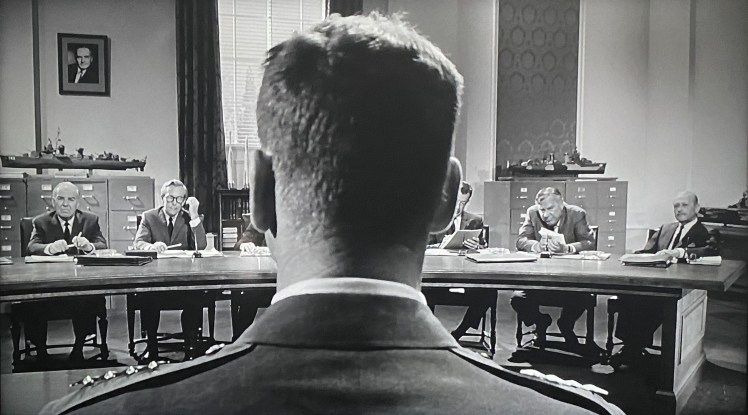
“Generals and Majors Everywhere” (review of John Frankenheimer’s SEVEN DAYS IN MAY), Perisphere, September 13, 2024. “Watching the film 60 years later, one marvels at how Trump’s tenure in the Oval Office [has] shifted the liberal mindset from fearing a military coup to welcoming one.”
“Big With Child” (review of Delphine and Muriel Coulin’s 17 GIRLS), Chicago Reader, July 26, 2012. “French sisters Delphine and Muriel Coulin … have turned [a true story of teenage girls in Massachusetts agreeing to get pregnant and raise their children together] into something rather French—not a cautionary tale of society unraveling but a drama of lower-class girls whose sweet sense of sorority blooms into a misguided utopianism. For them pregnancy is power: making their own babies, they can make their own world.”
“A Southerner in the Snow” (review of David Gordon Green’s SNOW ANGELS), Chicago Reader, March 20, 2008. “One can easily imagine what attracted Green to [Stewart O’Nan’s novel Snow Angels]. Butler, the small town north of Pittsburgh where O’Nan set his story, doesn’t seem much different in character from the southern towns in Green’s early films: as in any small community, the people all know each other, and when tragedy strikes, it touches them all.”
“The Price of Privacy” (review of David Fincher’s THE SOCIAL NETWORK), Chicago Reader, September 30, 2010. “The movie portrays [Facebook founder] Zuckerberg as a first-class heel, a supremely arrogant tech nerd driven by his hunger for social status, and it seems destined to define him publicly. Watching The Social Network, the real Zuckerberg may feel as if someone has hacked into his Facebook account and changed his profile picture.”
“The Bi- Who Loved Me” (review of Sam Mendes’ SKYFALL), Chicago Reader, November 15, 2012. “About midway through the story, [James] Bond (Daniel Craig) has been captured and tied to a chair by the blond, mincing supervillain Raoul Silva (Javier Bardem), who grabs his knees and comes on to him. ‘There’s a first time for everything,’ Silva points out. Bond grins and retorts, ‘What makes you think this is my first time?’ Can you imagine Connery engaging in this sort of man-on-man innuendo? When Craig took over the role in Casino Royale (2006), every blogger on earth informed us this was ‘not your father’s James Bond.’ To judge from Skyfall, he may not be your mother’s either.”
“Because I Said So” (review of Kyle Patrick Alvarez’s THE STANFORD PRISON EXPERIMENT and Michael Almereyda’s EXPERIMENTER), Chicago Reader, October 29, 2015. “Subjects in the experiment, conducted over several months by social psychologist Stanley Milgram, were [ordered to administer severe electrical shocks to an innocent victim and] told it was a study of how punishment affects learning, but the whole electroshock drama was a hoax, the victim an actor. What Milgram really wanted to learn was how people can be conditioned to commit barbarous acts.”
“Crack Panther” (review of Director X’s SUPERFLY), Chicago Reader, June 21, 2018. “The original Super Fly [1972] … provoked a giant backlash from the middle-class black community, who were incensed by its ghetto stereotypes and glamorization of the drug economy. According to legend, the very term blaxploitation was coined specifically to denigrate Super Fly. Now that Black Panther has exceeded the wildest commercial dreams of those earlier filmmakers, the new Superfly seems even more like an embarrassing throwback.”
“Good From the First Shot” (review of Danny Boyle’s T2: TRAINSPOTTING), Chicago Reader, March 23, 2017. “The heightened realism of the New Hollywood brought a wave of serious dramas involving heroin—The Panic in Needle Park (1971), The French Connection (1971), Lady Sings the Blues (1972), Lenny (1974)—that portrayed junkies as pathetic if not disgusting. Even the relatively recent spate of films accompanying the Gen-X heroin boom—Drugstore Cowboy (1989), Rush (1991), The Basketball Diaries (1995)—had proven to be traditional cautionary tales. But Trainspotting, which American critics compared endlessly to A Hard Day’s Night, made heroin fun.”
“Truer Grit” (review of Joel and Ethan Coen’s TRUE GRIT), Chicago Reader, December 23, 2010. “In the John Wayne version of True Grit, there’s a sentimental scene in which Mattie tells Rooster she’s reserved a spot for him next to her in the family cemetery; the implication is that, in years to come, she’ll find a man just like him. The Coens’ movie preserves the more poignant denouement of Portis’s novel, in which the two characters are separated by fate and never meet again.”
“Amelie Goes to Hollywood” (review of Jean-Pierre Jeunet’s A VERY LONG ENGAGEMENT), Chicago Reader, December 17, 2004. “Based on Sebastien Japrisot’s 1991 novel Un long dimanche de fiancailles, Jeunet’s adaptation is a fierce antiwar statement in the style of Paths of Glory and All Quiet on the Western Front, though like its doomed soldiers A Very Long Engagement has been abandoned by its nation. Last month a French court declared the movie ineligible for film festivals as a French release because its production company, 2003 Productions, is one-third owned by an American studio, Warner Brothers.”
“Money for Silence” (review of Basil Dearden’s VICTIM), Chicago Reader, March 21, 2018. “Victim [1961] stops well short of laying down a marker in gay cinema. … In line to become a queen’s counselor and maybe even a judge, [closeted London barrister Melville] Farr is portrayed as a happily married man nobly fighting off his worst impulses, and at the end, he and his prim wife (Sylvia Sims) live hetero ever after. Victim may be more illuminating now for the smaller characters on the periphery, whose remarks constitute an inventory of British attitudes in a rapidly changing era.”
“An Actor’s Director” (review of Tom McCarthy’s THE VISITOR), Chicago Reader, April 17, 2008. “McCarthy achieves a similar alchemy in The Visitor with Richard Jenkins, for whom he wrote the role of Walter Vale, a middle-aged economics professor grappling with the death of his concert pianist wife. … Jenkins, a balding, bespectacled character actor perhaps best known as the ghostly father on Six Feet Under, has enjoyed a long Hollywood career playing dry, buttoned-down types—doctors, lawyers, executives—and he seizes on the role of Walter, a man no one seems to notice.”
“Rebel Without a Script” (review of Nicholas Ray’s WE CAN’T GO HOME AGAIN and Susan Ray’s Don’t Expect Too Much), Chicago Reader, January 19, 2012. “We Can’t Go Home Again … is often arresting but more often tedious, a game but failed attempt to marry experimental techniques to an improvised story. Don’t Expect Too Much, on the other hand, is an important addition to Ray’s life story, a troubling account of a 60-year-old artist, once great but now awash in a sea of drink and drugs, as he tries to connect with people 40 years his junior.”
“A Film of One’s Own” (review of “LOIS WEBER: Pioneer Progressive Filmmaker”), Chicago Reader, April 6, 2017. “At the dawn of the movies, [Hollywood director Lois Weber] laid down a marker for the sort of socially committed drama we still see in filmmakers like Courtney Hunt (Frozen River), Debra Granik (Winter’s Bone), and Kelly Reichardt (Wendy and Lucy). Yet Weber’s films are also deeply informed by her ideas about class, and progressives today might find some of them startling.”
“The Body and the Soul in The Whale” (review of Darren Aronofsky’s THE WHALE), Living Lutheran, March 7, 2023. “As a filmmaker, Aronofsky is well-acquainted with the weight of the human body: The Wrestler (2008) starred Mickey Rourke as a scarred, washed-up fighter, and Black Swan (2010) followed Natalie Portman’s character through the punishments of professional ballet. The Whale never looks away from Charlie’s obesity or what it means for him physically or emotionally. When his daughter, now 17 and exploding with rage and recrimination, demands to know why he was never part of her life, Charlie answers with a leveling stare: ‘Look at me. Who would want me to be part of their life?'”
“None of That Jazz” (review of Damien Chazelle’s WHIPLASH), Chicago Reader, October 30, 2014. “Tracking the conflict between Fletcher—the sadistic, screaming, superhumanly precise conductor of a big band at a prestigious New York conservatory—and a dedicated, play-till-your-hands-bleed drumming student, Whiplash has less in common with the great jazz dramas (Robert Altman’s Kansas City, Bertrand Tavernier’s Round Midnight) than with a much more plentiful cultural commodity, the inspirational sports drama.”
“Family Values in Meth Country” (review of Debra Granik’s WINTER’S BONE), Chicago Reader, June 17, 2010. “Just as movies set in the big city can seem placeless, movies set in the remotest parts of the country can seem timeless. Here the 21st century is represented mainly by its garbage, whether it’s behavioral (the meth), cultural (the Korn-style metal one character listens to on his outdated boom box), or material (a junked satellite dish decorating one yard, along with the usual cars, scrap metal, and other detritus). By contrast, the community’s values are as unchanged as the mountain terrain: people are contemptuous of the law, rigid in their ideas about men and women, and haunted by an old-fashioned feeling of responsibility toward one another.”
“Gay Cinema Enters the Post-Taboo Era” (review of Stephen Cone’s THE WISE KIDS), Chicago Reader, November 3, 2011. “Given the ongoing friction between gay rights and Christian fundamentalism, what really distinguishes The Wise Kids from most gay films—in fact, most films, period—is how evidently Cone respects religious devotion. … The movie opens with a few lightly comic moments as the classmates rehearse for an Easter pageant (Jesus manages to fall off the cross), but its closing scene of some of the same characters dressed as angels for a nighttime Christmas ceremony is presented without a trace of irony.”
“Light in Auggie” (review of Stephen Chbosky’s WONDER), Chicago Reader, November 16, 2017. Reprinted in For Kids of All Ages: The National Society of Film Critics on Children’s Movies, ed. Peter Keogh (Lanham, MD: Roman & Littlefield, 2020). “Seeing one’s body carved up and reassembled can be horrifying for a child; I still remember the grinning doctor who, having painfully cut through and plucked out the stitches in my chest and drawn out a length of black surgical thread, handed me the tweezers and asked if I wanted to finish the job myself. At some point there was talk of drilling a hole through my skull to create an auditory canal, but when I was in sixth grade my parents decided enough was enough and the surgeries ended, leaving my ear like an unfinished swimming pool.”
“When Princesses Grow Up” (review of Jean-Marc Vallee’s THE YOUNG VICTORIA), Chicago Reader, December 17, 2009. “[Screenwriter Julian] Fellowes, who moonlights as a speechwriter for Tory politicians, has imbued The Young Victoria with a fairly sophisticated understanding of constitutional monarchy, and the queen’s tactical victories are always tempered by the reality that her power is largely ceremonial. The script is also cleverly structured so that each of Victoria’s male antagonists is dearer to her than the last and, as a result, more difficult to handle. In the end The Young Victoria is a story not of regal triumphs but of grown-up compromises and accommodations.”
“Armed, Dangerous, and Completely Ordinary” (review of Ben Coccio’s ZERO DAY), Chicago Reader, April 23, 2004. “Based on the Columbine story, [Zero Day] unfolds mostly as a ten-month video diary by two high school misfits… as they meticulously plan their revenge on the school. … Unlike the mouth-breathing goons [Columbine perpetrators] Harris and Klebold were portrayed as, Andre and Calvin are bright, funny, and insightful. I truly enjoyed their company, which made the countdown to their ‘mission’ even more dreadful. I kept hoping they’d change their minds at the last minute, and when they were merrily executing their fellow students in blurry surveillance-camera footage, I caught myself wishing I’d done something to stop them.”
 jrjones.online